



The Real Estate DATA HUB | Real Estate in Italy: Space, Quality, and Sustainability as new priorities for Investors and Families
|
|


From 2024 Consolidation to 2025 Trends: ESG Criteria, Build To Rent, the “Return of the Provinces”, and the Rise of Green Mortgages. The Real Estate DATA HUB Captures the New Geographies of Real Estate in Italy
The Italian Real Estate market is undergoing a transformation. More flexible living models, a growing attention to sustainability, and the renewed centrality of provincial areas are reshaping the value map, while investments are starting to grow again. Demand is evolving and redistributing, in favour of comfort and space optimisation. This explains the increasing appeal of the provinces, which are gaining ground compared to the main cities, reflecting a greater focus on quality of life. After the stabilisation phase in 2023, 2024 marked a turning point, with the total investment volume rising to nearly 10 billion euros – an increase of over 50% compared to the previous year – although individual sectors showed different trends. In particular, analyses highlight a revival of the office sector, driven by growing interest from Italian and international investors in sustainable properties aligned with ESG criteria. The retail market saw a strong increase and, thanks also to the entry of new players, is establishing itself as a strategic asset class, especially in the North- East, North- West, and South Italy. Investments in the hospitality sector also rose significantly, focusing on resorts and branded residences—an emerging trend for 2025. There are signs of growth in the residential sector and substantial stability in logistics, which experienced a consolidation phase in 2024, with a 10% increase in rents for new constructions and a strong restart expected in 2025.
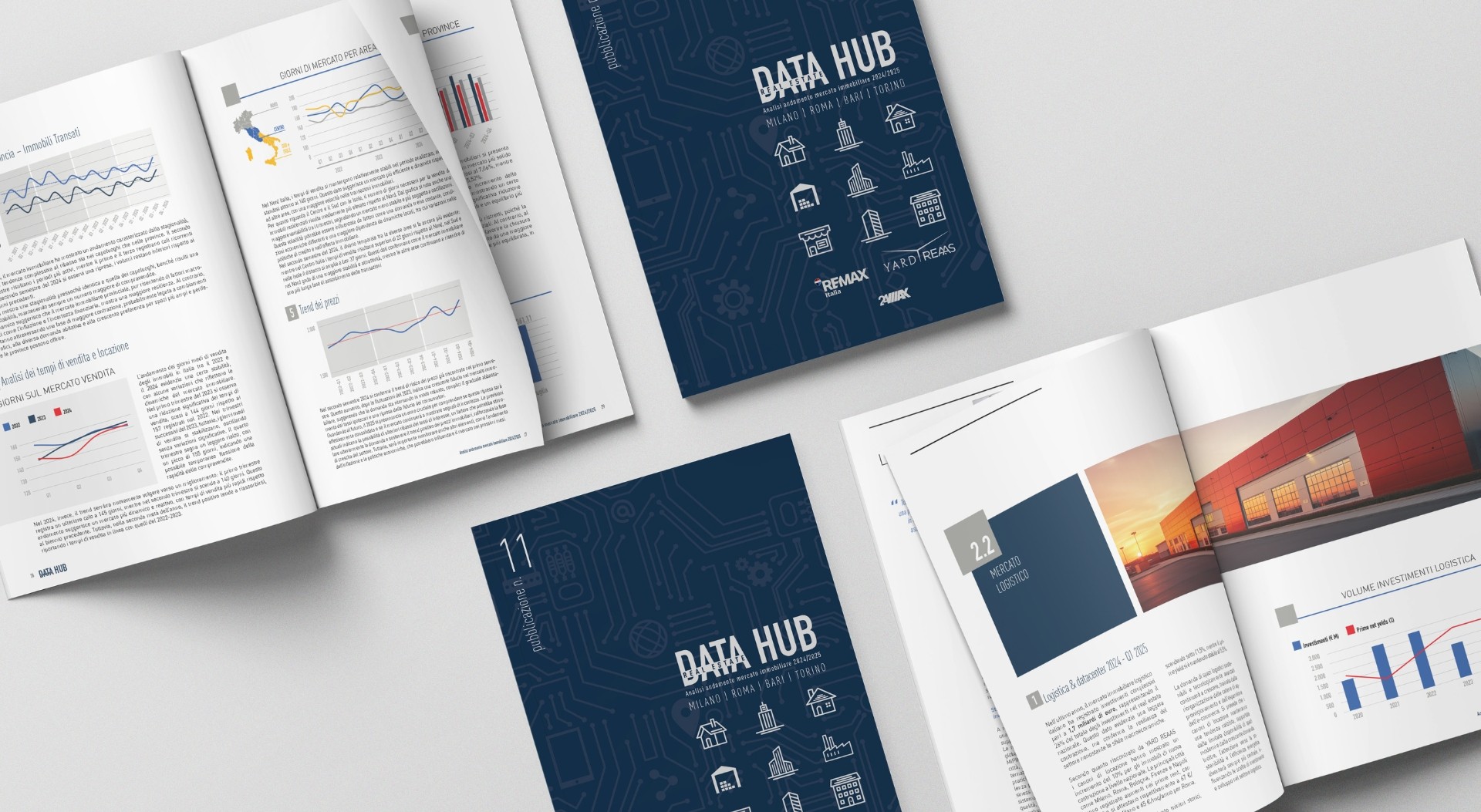
This is the picture that emerges from the latest edition of the Real Estate DATA HUB, the half-year market report produced by the Research Center of REMAX Italy, the Research Office of YARD REAAS, and the Research Office of 24MAX, which offers an analysis of the Real Estate market in Italy in 2024 and anticipates the outlook for 2025. This edition addresses particular attention to the dynamics of Milan, Rome, Bari, and Turin, along with their respective regions, analysing the asset classes of living, luxury, logistics and data centers, office, retail, and hospitality.
RESIDENTIAL: THE NEW APPEAL OF THE SUBURBS
In 2024, the residential market progressively recovered: after a decline in the first half of the year, the second half saw an increase in transactions and an average price rise exceeding 3%. Lombardy confirmed its position as the leading region by number of transactions, accounting for 35% of the total. In Northern Italy, Liguria, Veneto, and Piedmont showed growing performance; in Central Italy, Lazio held the top position, followed by Emilia-Romagna and Tuscany; in the South, Apulia and Campania stood out for significant transaction volumes, while Sicily remained the most relevant market among the islands.
Milan remained the province with the highest transaction volume, followed by Rome and Turin. At the national level, the DATA HUB analysis confirms the continued attractiveness of metropolitan areas, alongside a progressive expansion of demand towards well-connected suburban zones. “It’s no longer just about square meters, but about services, context, and well-being,” comments Dario Castiglia, CEO & Founder of REMAX Italia. “The market is gaining new momentum thanks to increased supply in areas that until a few years ago were considered secondary.” Three-room apartments are the most requested type, especially in Northern Italy (46% of preferences), while in the South, four-room and larger units are growing in popularity, helped by greater price accessibility. “Looking ahead to 2025, the outlook for the Real Estate market remains positive,” Castiglia states. “Current forecasts indicate the possibility of further interest rate cuts, a factor that could further stimulate demand and strengthen the sector’s growth phase.”
MORTGAGE TRENDS: PRIMARY RESIDENCE DOMINATES, GROWING OF GREEN LOANS AND YOUNG BORROWERS
The mortgage market benefits from a more favourable environment, thanks to ECB rates cuts and tools such as the “Fondo di Garanzia Prima Casa” (Primary Residence Guarantee Fund). 97.5% of applicants are seeking mortgages to purchase their primary residence, with a clear dominance of fixed-rate loans (97.8%). Age group analysis shows that borrowers aged 35 to 44 make up 34% of applicants, followed by younger borrowers aged 25 to 34, who represent 32.4%. These figures signal a return to planning, especially among young families and first-time buyers. Requests for green mortgages, steadily increasing, now exceed 10% of the total, reflecting growing attention to sustainability and energy efficiency even in financing choices.
RETAIL, OFFICE, LOGISTICS AND HOSPITALITY: NEW PRIORITIES FOR INVESTORS AND TENANTS
The Real Estate DATA HUB also provides an overview of the performance of other market segments, confirming the growing interest in resilient and integrated assets. Retail stands out as leader in 2024, with record investment volumes and widespread growth across the country. The entry of new players and the dynamism of certain specific segments have contributed to the sector’s vitality, with positive perspectives for the rest of 2025. In the office sector, there is a consolidation of interest in flexible, well-located spaces capable of adapting to hybrid work models, along with growing attention to next-generation properties aligned with ESG criteria. Logistics demonstrated overall stability in 2024, despite a slight contraction in its share of total investments and showed a positive start in 2025. The hospitality sector remains stable, supported by increasing interest in luxury hospitality. “We are witnessing the consolidation of several macro-trends, such as the growing importance of ESG factors – evident, for example, in the spread of green financing and in the investment and tenant choices, not only in the office segment. At the same time, the role of services supporting properties and their occupants is strengthening; this is exemplified by Build to Rent (BTR), an asset class that is also gaining ground in the Italian market,” explains Laura Piantanida MRICS, Head of Institutional Relations at Yard Reaas SpA.
REAL ESTATE DATA HUB
Produced by the Research Center of REMAX Italia, the Research Department of YARD REAAS, and the Research Office of 24MAX, the Real Estate DATA HUB offers an in-depth analysis of Italy’s residential and commercial property market, confirming its position as a key analytical tool for industry professionals. Thanks to a wealth of data, thematic insights, and contributions from experts and opinion leaders, it provides a comprehensive and up-to-date snapshot of the Italian real estate sector.
This edition addresses particular attention to the dynamics of Milan, Rome, Bari, and Turin, along with their respective regions, analysing the asset classes of living, luxury, logistics and data centers, office, retail, and hospitality.